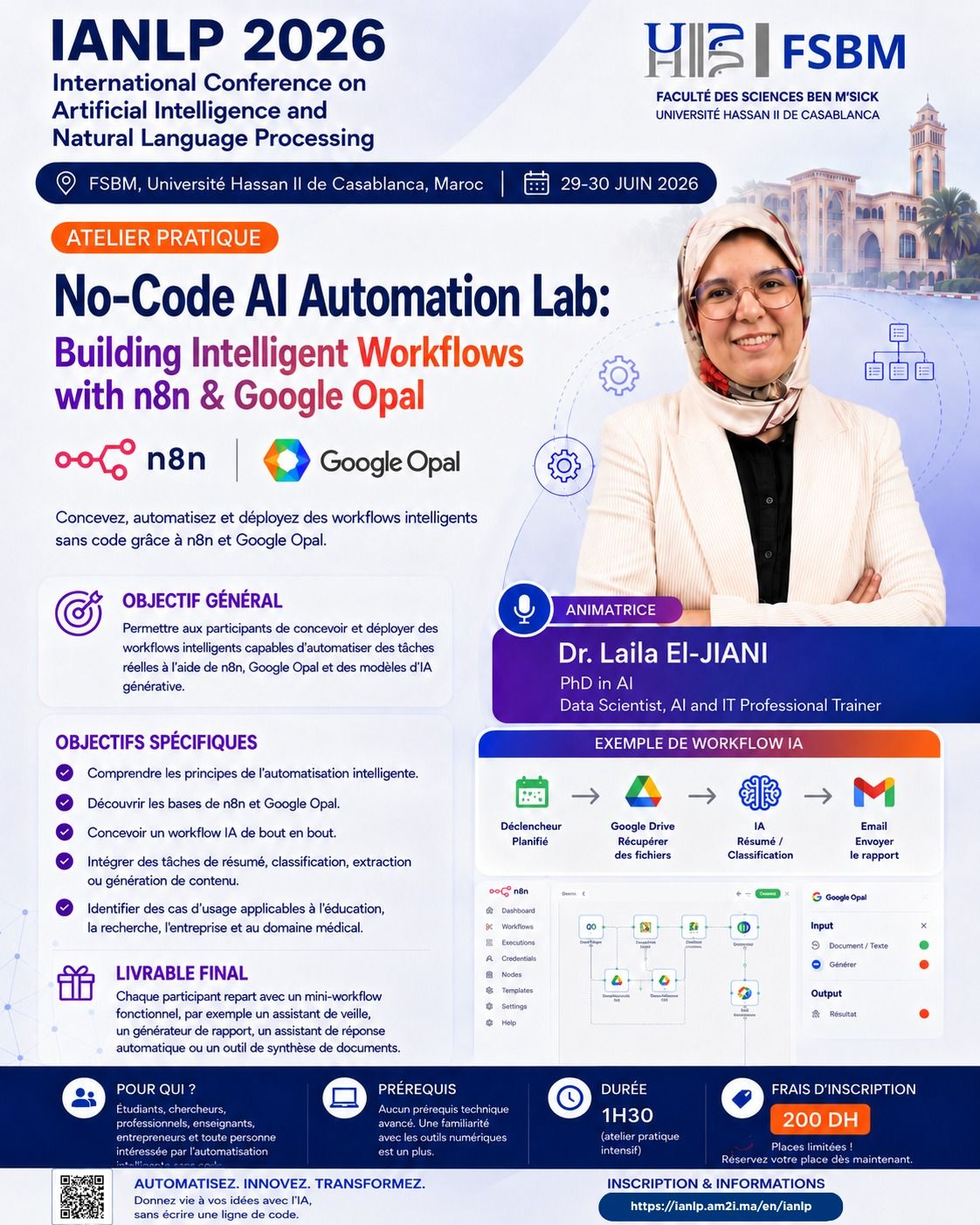
No-Code AI Automation Lab: Building Intelligent Workflows with n8n & Google Opal
Practical Workshop — IANLP 2026
Design, automate, and deploy intelligent no-code workflows using n8n, Google Opal, and generative AI. Enable participants to build end-to-end workflows that automate real-world tasks such as scientific monitoring, document summarization, file classification, report generation, and smart assistants. Each participant leaves with a functional mini-workflow (monitoring assistant, report generator, automated response assistant, or document summarizer).
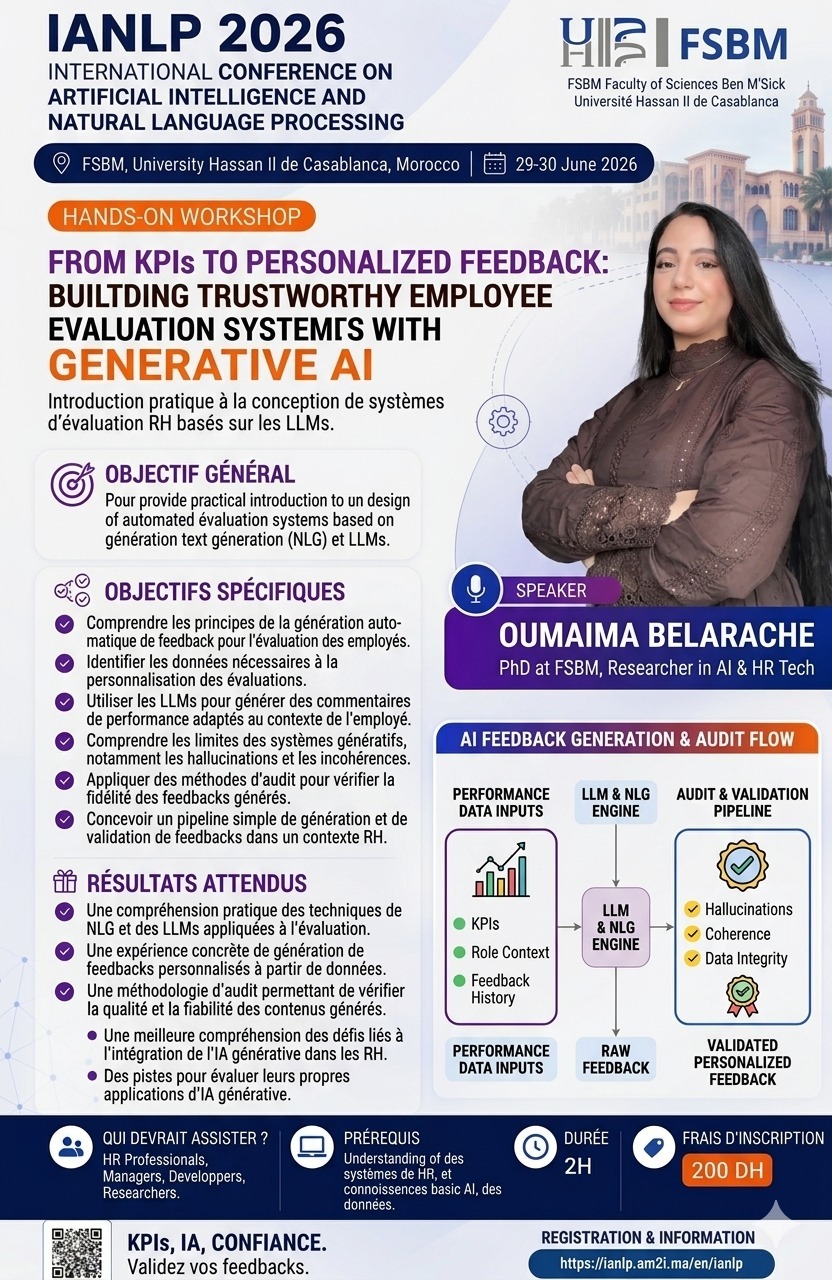
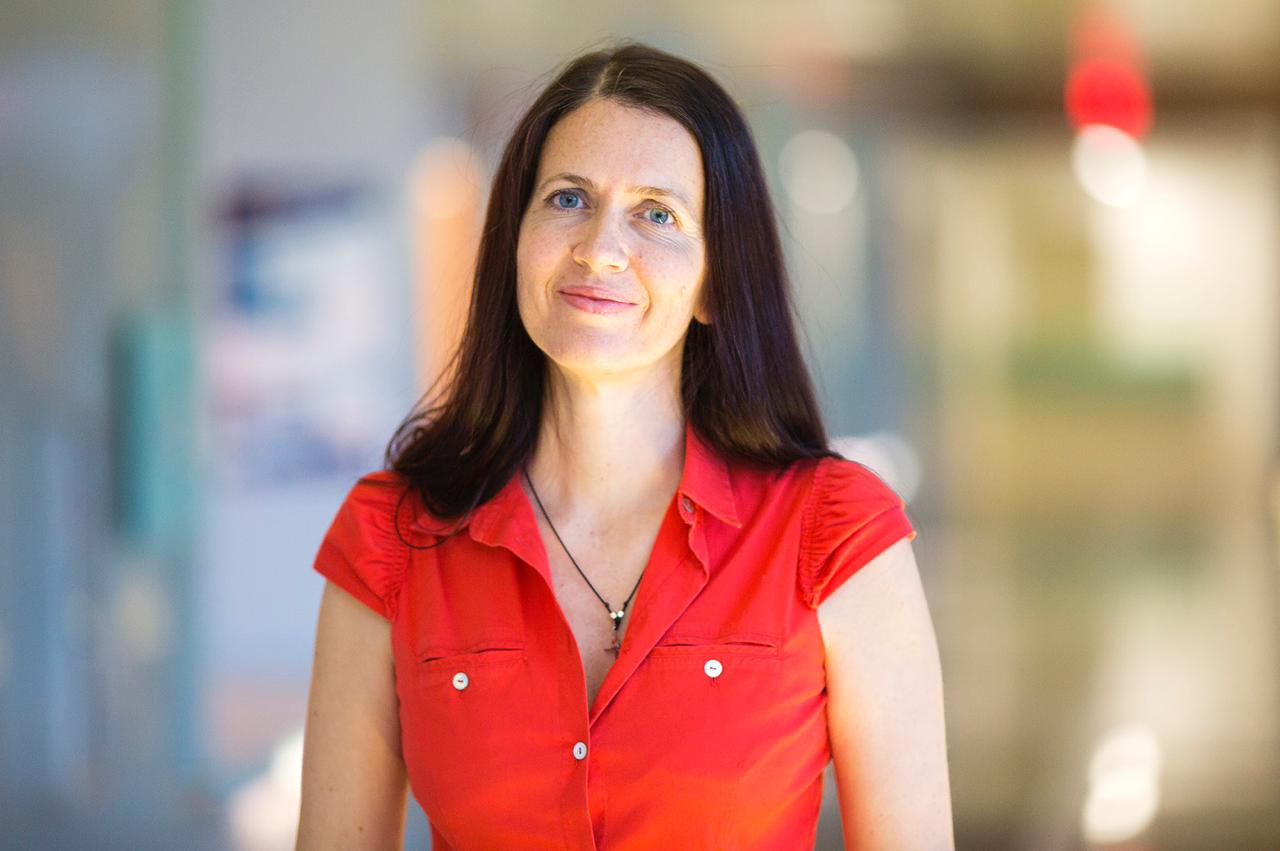
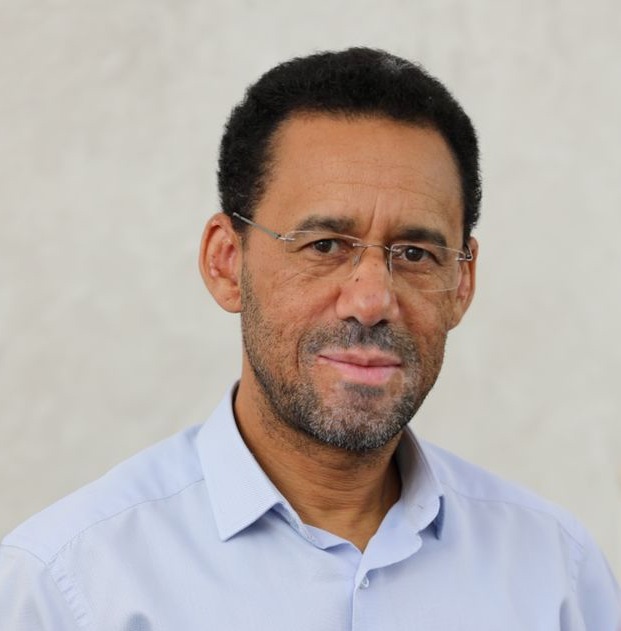
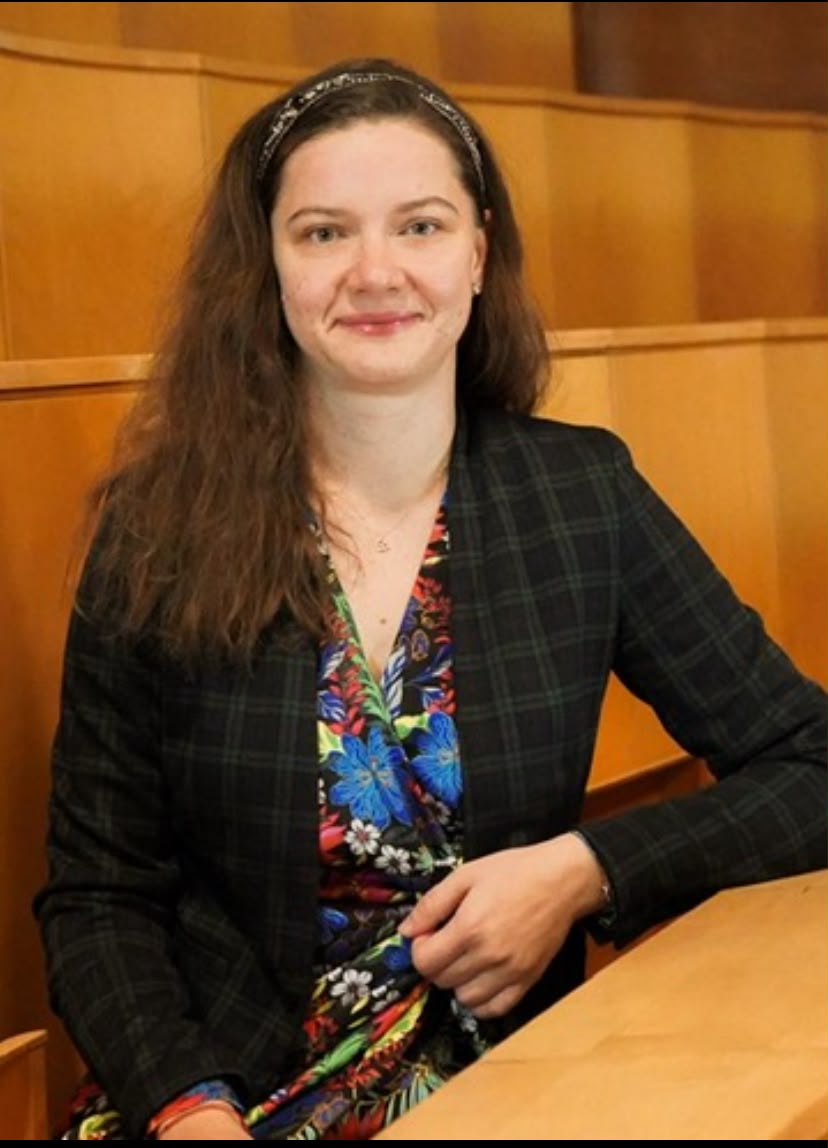
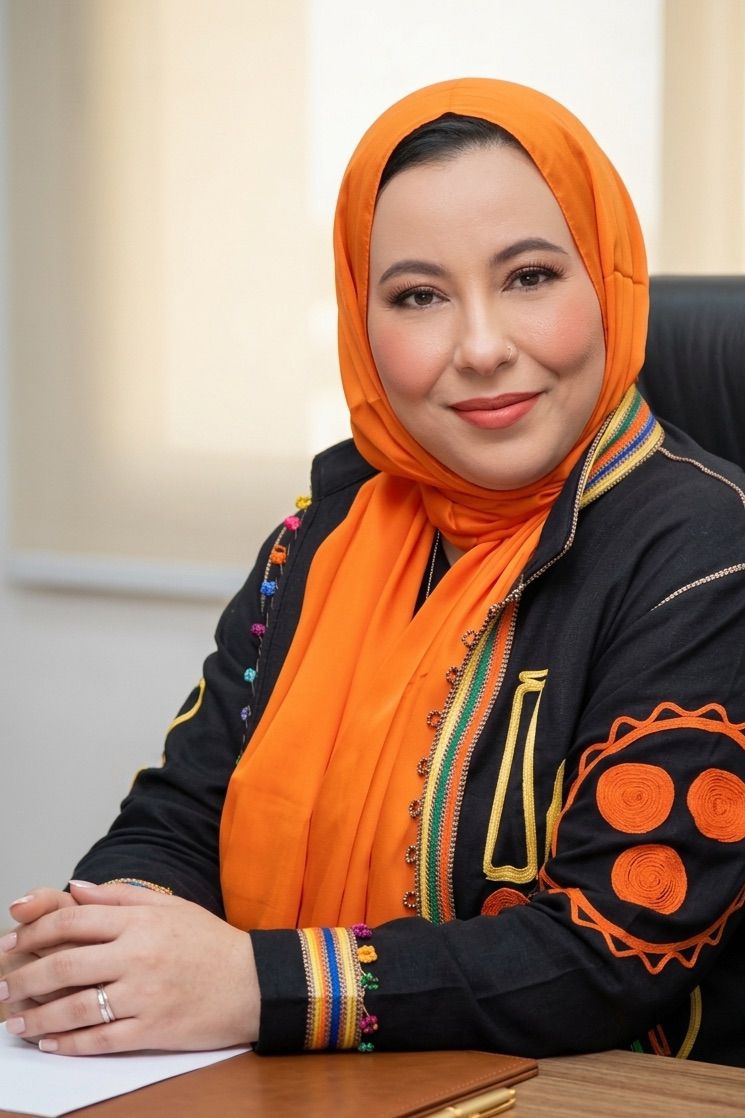
Facilitator
Dr. Laila El-JIANI
PhD in AI — Data Scientist, AI and IT Professional Trainer
Understand the principles of intelligent automation
Discover the basics of n8n and Google Opal
Design an end-to-end AI workflow (Scheduled Trigger → Google Drive → AI Summary/Classification → Email report)
Integrate tasks for summarization, classification, extraction, or content generation
Identify use cases for education, research, business, and healthcare
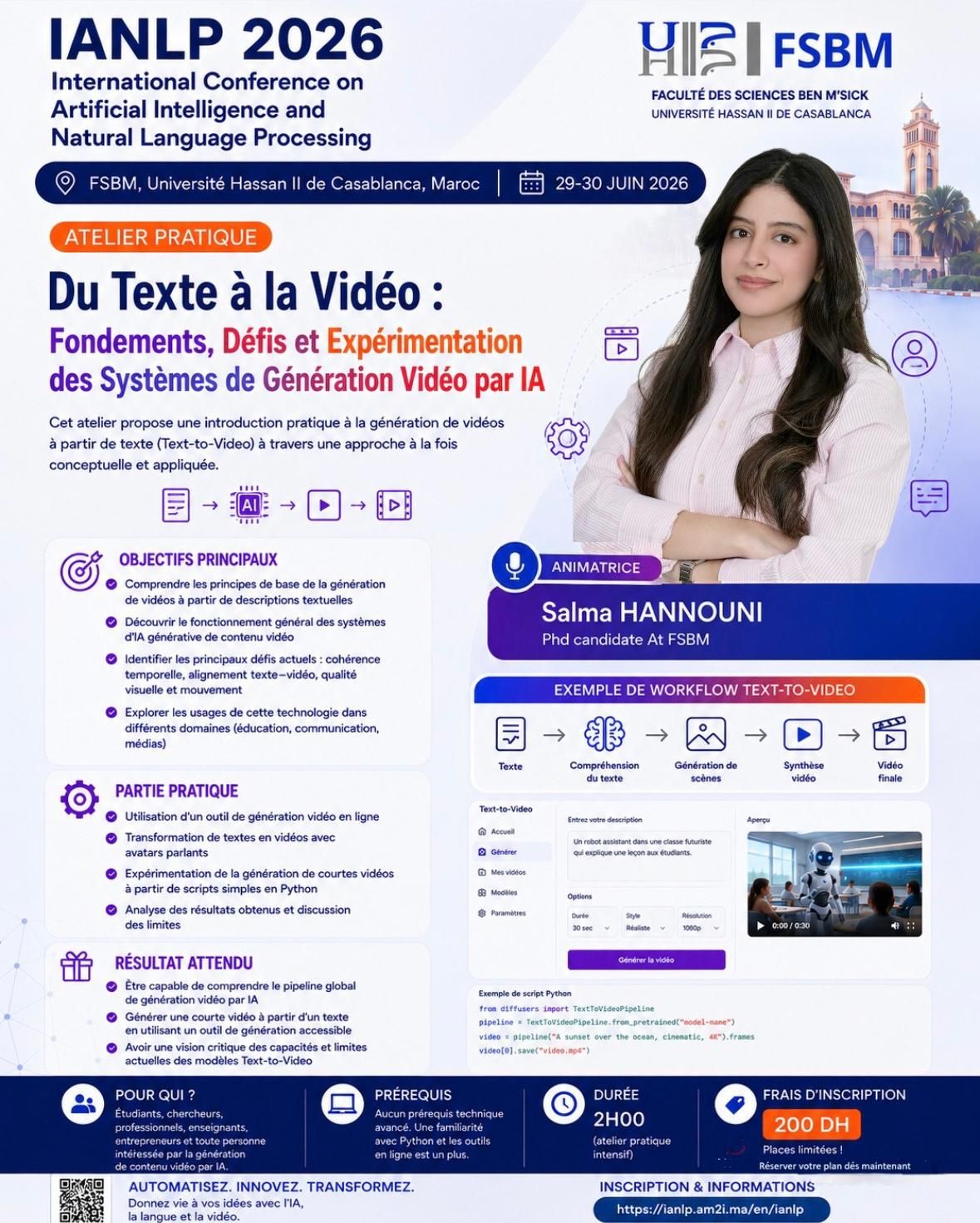
From Text to Video: Foundations, Challenges & Experimentation of AI Video Generation Systems
Practical Workshop — IANLP 2026
A practical introduction to text-to-video generation through both conceptual and hands-on approaches. Understand how generative AI turns text into video, explore current challenges (temporal coherence, text-video alignment, visual quality, movement), and experiment with online tools and simple Python scripts. Participants leave able to understand the full AI video pipeline, generate a short video from text, and critically assess current Text-to-Video capabilities and limits.
Facilitator
SALMA HANNOUNI
PhD candidate — Faculty of Sciences Ben M'Sick (FSBM), Hassan II University of Casablanca
Understand the basic principles of video generation from text descriptions
Discover how generative AI systems produce video content (Text → Understanding → Scene Generation → Video Synthesis → Final Video)
Identify current challenges: temporal coherence, text-video alignment, visual quality, and movement
Explore applications in education, communication, and media
Hands-on: use an online video generation tool with talking avatars
Hands-on: experiment with short video generation using simple Python scripts
Analyze results and discuss current model limitations
Expected outcome: generate a short video from text and develop a critical view of Text-to-Video capabilities
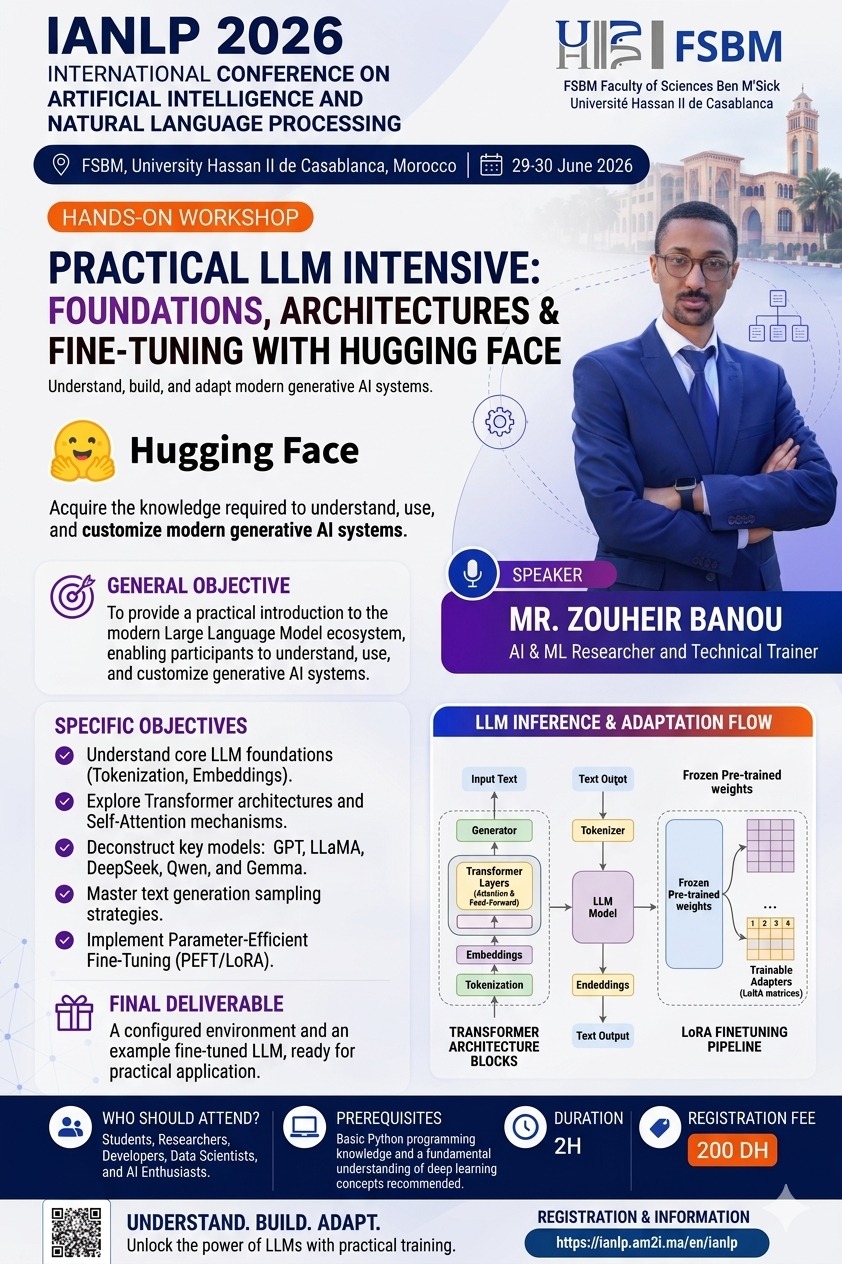
Practical LLM Intensive: Foundations, Architectures & Fine-Tuning with Hugging Face
Hands-On Workshop — IANLP 2026
A practical introduction to the modern Large Language Model ecosystem. Understand, build, and adapt modern generative AI systems with Hugging Face — from tokenization and Transformer architectures to inference, sampling strategies, and Parameter-Efficient Fine-Tuning (PEFT/LoRA). Participants leave with a configured environment and an example fine-tuned LLM ready for practical application.
Facilitator
Mr. Zouheir Banou
AI & ML Researcher and Technical Trainer
Core LLM foundations: tokenization and embeddings
Transformer architectures and self-attention mechanisms (Input Text → Tokenization → Embeddings → Transformer Layers → Generator → Text Output)
Key models: GPT, LLaMA, DeepSeek, Qwen, and Gemma
Text generation sampling strategies
Parameter-Efficient Fine-Tuning (PEFT/LoRA) with Hugging Face — frozen pre-trained weights with trainable LoRA adapters
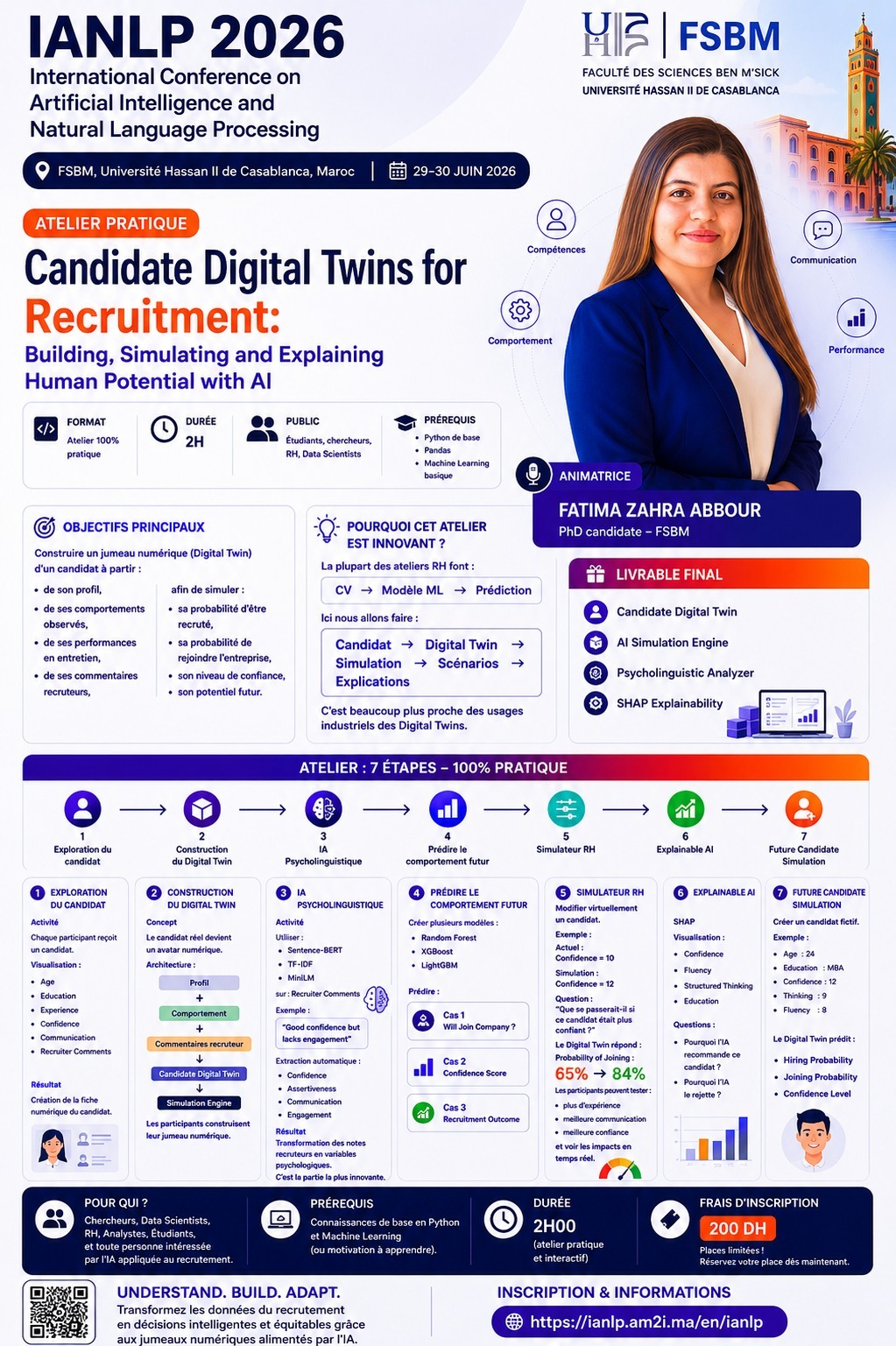
Candidate Digital Twins for Recruitment: Building, Simulating and Explaining Human Potential with AI
Practical Workshop — IANLP 2026
Build a "Digital Twin" of a candidate to simulate recruitment probability, likelihood of joining, confidence level, and future potential. Go beyond simple CV-to-prediction models with a Candidate → Digital Twin → Simulation → Scenarios → Explanations workflow. 100% hands-on.
Facilitator
Fatima Zahra Abbour
PhD candidate — Faculty of Sciences Ben M'Sick (FSBM), Hassan II University of Casablanca
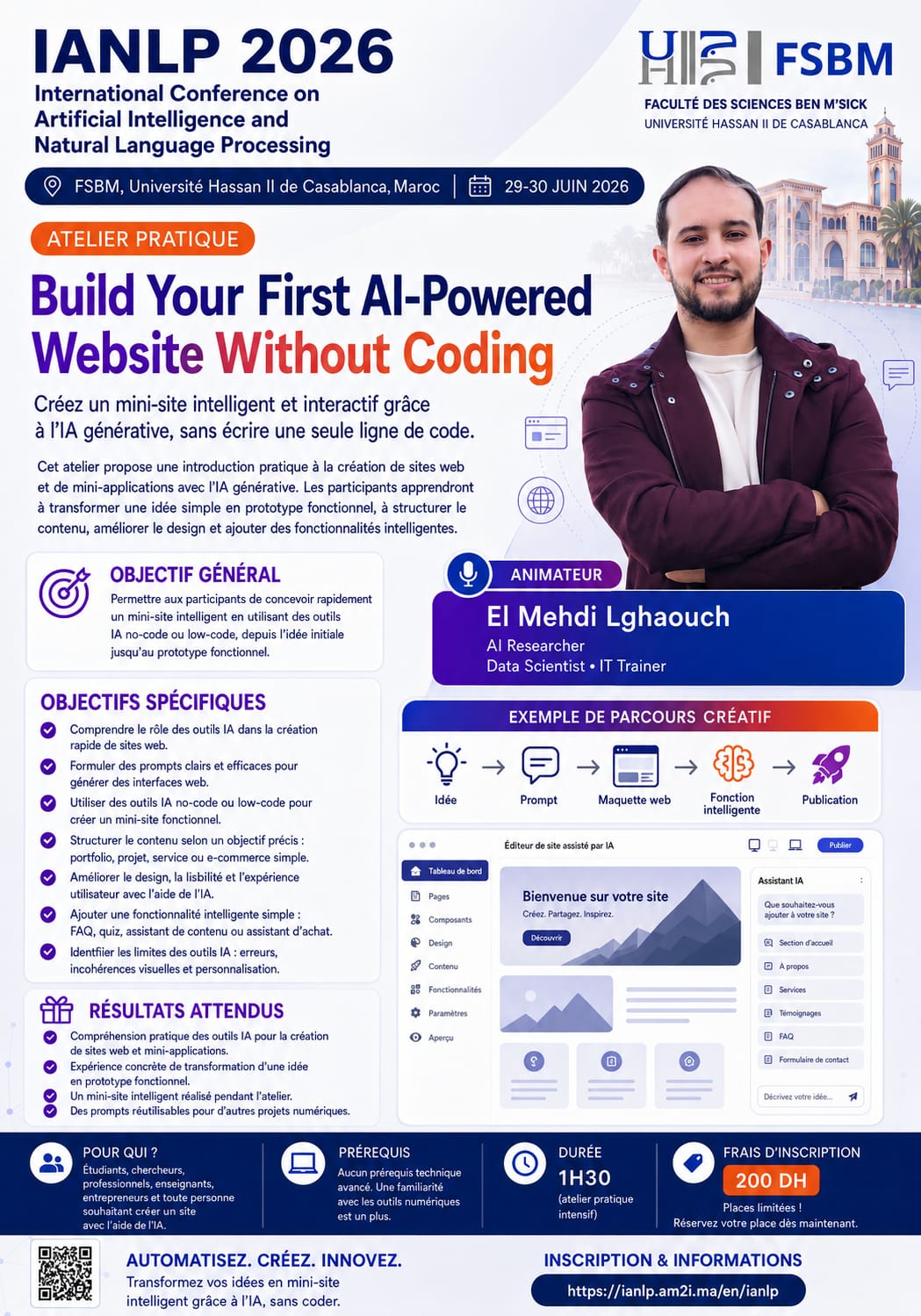
Build Your First AI-Powered Website Without Coding
Practical Workshop — IANLP 2026
A practical introduction to creating websites and mini-applications using generative AI. Learn to transform a simple idea into a functional prototype — structure content, improve design and UX, and add intelligent features — without writing a single line of code. Workflow: Idea → Prompt → Web Mockup → Smart Function → Publication.
Facilitator
El Mehdi Lghaouch
AI Researcher, Data Scientist, IT Trainer
Understand the role of AI tools in rapid website creation
Formulate clear and effective prompts for generating web interfaces
Use no-code/low-code AI tools to create a functional mini-site
Structure content for specific goals (portfolio, project, service, or e-commerce)
Improve design, readability, and UX with AI assistance
Add smart features (FAQ, quiz, content assistant, or shopping assistant)
Identify limitations of AI tools (errors, visual inconsistencies, and personalization)
From KPIs to Personalized Feedback: Building Trustworthy Employee Evaluation Systems with Generative AI
Hands-On Workshop — IANLP 2026
A practical introduction to designing HR evaluation systems based on natural language generation (NLG) and Large Language Models (LLMs). Learn to generate personalized performance feedback from KPIs, role context, and feedback history — then audit and validate outputs for hallucinations, coherence, and data integrity before delivery.
Facilitator
Oumaima Belarache
PhD candidate — FSBM, Researcher in AI & HR Tech
Understand principles of automatic feedback generation for employee evaluation
Identify data needed to personalize evaluations (KPIs, role context, feedback history)
Use LLMs to generate performance feedback adapted to each employee's context
Understand limits of generative systems — hallucinations and inconsistencies
Apply audit methods to verify fidelity of generated feedback (hallucinations, coherence, data integrity)
Design a simple pipeline: Performance Data → LLM/NLG Engine → Raw Feedback → Audit & Validation → Validated Personalized Feedback
Jump to the sections you need — from call for papers to submission and committees.
Speakers
We Invite Amazing Speakers
Keynote speakers will be announced soon. IANLP 2026 will invite internationally recognized speakers in emerging topics such as:
Prof. Rada Mihalcea
University of Michigan, Computer Science & Engineering
Rada Mihalcea is the Janice M. Jenkins Professor of Computer Science and Engineering at the University of Michigan and the Director of the Michigan Artificial Intelligence Lab. Her research spans natural language processing, large language and language-vision models, and computational social science, with a focus on cross-cultural and cross-lingual models, fairness, interpretability, and responsible AI deployment. She leads multiple interdisciplinary initiatives at the intersection of AI, health, education, and social impact, and has developed widely adopted datasets and computational methods. She served as Program Co-Chair for EMNLP 2009 and ACL 2011, General Chair for NAACL 2015 and *SEM 2019, and co-founded the ACL Mentorship Program, the TextGraphs workshop series, and the NLP for Positive Impact workshop series. She is an ACM Fellow, AAAI Fellow, ACL Fellow, AAA&S Fellow, and a former President of the ACL. She is a recipient of the Presidential Early Career Award for Scientists and Engineers awarded by President Obama.
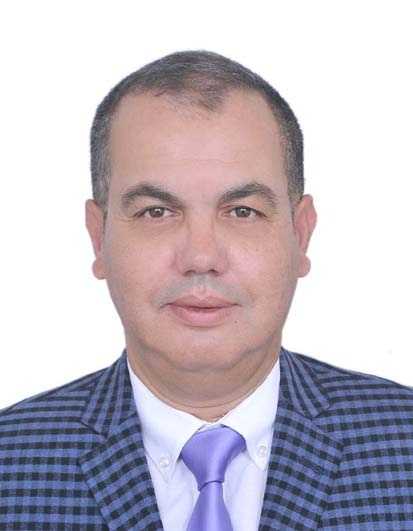
Pr. Jaouad DABOUNOU
Hassan I University , Morocco
Prof. Jaouad DABOUNOU is a Professor at Hassan First University, Faculty of Sciences and Techniques (FST), Settat, Morocco, where he has been teaching since 1994. He earned his doctorate in Modeling of Solids and Structures from UTC, France.
His research focuses on Applied Mathematics and Artificial Intelligence, with particular interest in the development and deployment of AI solutions across multiple domains.
He is the Director of the Artificial Intelligence Research and Applications Laboratory (AIRA), where he leads and coordinates research projects related to artificial intelligence and territorial information systems.
Dr. Pepa Atanasova
University of Copenhagen, Denmark
Dr. Pepa Atanasova is a tenure-track Assistant Professor in the AI Section at the University of Copenhagen, where she co-leads the NLP group CopeNLU. Her research focuses on making language models trustworthy, transparent, and accountable, investigating the internal mechanisms behind model outputs to steer them toward safer, more factual behaviour. She co-directs an interdisciplinary Trustworthy AI programme and leads a synergy project on trustworthy human-AI interaction, with particular attention to emergent deception in AI-mediated communication.
Pr. Omar TANANE
Hassan II University of Casablanca, FSBM
Professor Omar Tanane is a researcher and lecturer at Hassan II University in Casablanca, specializing in electrochemistry, chemical engineering, and environmental chemistry. Holding a Ph.D. in electrochemistry and a management degree from ISCAE Business School, he has contributed significantly to innovation, securing six patents related to corrosion inhibition, environmental protection, and materials recycling. His research spans Artificial Intelligence in materials science, exploring machine learning for material discovery and robotics, notably co-developing a robotic system for scorpion venom extraction. With twenty-four scientific publications, he was awarded the Best Paper Award in 2013. Since 1992, he has been a faculty member at Hassan II University, leading Technology and Innovation Support Centers (TISC) at the Moroccan Industrial and Commercial Property Office, holding certifications from WIPO and GIPA. His work bridges academic research, intellectual property, and technological innovation.
Pr. Khadija Achtaich
LTIM, Hassan II University of Casablanca, FSBM
Prof Khadija Achtaich is a researcher specializing in the application of AI to heritage preservation and healthcare, her work focuses on developing intelligent solutions for medical diagnosis and optimizing care pathways. She is actively dedicated to technological innovation and science communication to improve health literacy and digital inclusion.
Topics
Main Thematic Areas
Non-exhaustive list of research areas and topics we welcome at IANLP 2026
Artificial Intelligence and Machine LearningNatural Language Processing and Large Language ModelsGenerative AI and Agentic SystemsData Science and Knowledge DiscoveryComputer Vision and Pattern RecognitionResponsible, Explainable and Trustworthy AIIntelligent Information SystemsDigital Transformation and Smart ApplicationsIoT, Edge Intelligence and Smart EnvironmentsCybersecurity and AI for SecurityAI for Education, Health, Industry and SocietyEmerging Computing and Interdisciplinary Applications
Topics
Special Focus Areas
Beyond the broad thematic areas above, IANLP 2026 highlights four research tracks where submissions are especially encouraged.
Core NLP Tasks
Classification, Named Entity Recognition, Parsing, Summarization, Machine Translation
Education, Healthcare, Legal Tech, Finance, Industry Applications
Call for Papers
Call for Papers
IANLP 2026 invites original and unpublished research contributions in Artificial Intelligence for Natural Language Processing. Submissions must present novel scientific results and be written in English.
Faculty of Sciences Ben M'Sick (FSBM), Hassan II University of Casablanca, Morocco
Organizing Institution
AM2I & LTIM & FSBM
Hassan II University of Casablanca, Bd Commandant Driss Al Harti, Casablanca 20670, Morocco
Committees
Organizing Committee
Team members coordinating the logistics and operations of IANLP 2026
A
Prof. Ahajjam Tarik
Faculty of Sciences Ben M'Sick (FSBM), Hassan II University of Casablanca, Morocco
A
Prof. Ardchir Soufiane
ENCG Casablanca - Hassan II University of Casablanca, Morocco
A
Prof. Azzouazi Mohamed
Faculty of Sciences Ben M'Sick (FSBM), Hassan II University of Casablanca, Morocco
B
Prof. Ben Derkawi Zakaria
Faculty of Sciences Ben M'Sick (FSBM), Hassan II University of Casablanca, Morocco
B
Prof. Benamri Ichrak
Faculty of Sciences Ben M'Sick (FSBM), Hassan II University of Casablanca, Morocco
B
Prof. Benlahmar El Habib
Faculty of Sciences Ben M'Sick (FSBM), Hassan II University of Casablanca, Morocco
B
Prof. Bentaib Mohssine
Faculty of Sciences Ben M'Sick (FSBM), Hassan II University of Casablanca, Morocco
C
Prof. Charif Ahmed
Faculty of Sciences Ben M'Sick (FSBM), Hassan II University of Casablanca, Morocco
C
Prof. Chemlal Yman
Faculty of Sciences Ben M'Sick (FSBM), Hassan II University of Casablanca, Morocco
D
Prof. Daif Abderrahmane
Faculty of Sciences Ben M'Sick (FSBM), Hassan II University of Casablanca, Morocco
E
Prof. El Ghoumari Mohamed Yassine
ENCG - Hassan II University of Casablanca, Morocco
G
Prof. Ghazouani Mohamed
Faculty of Sciences Ben M'Sick (FSBM), Hassan II University of Casablanca, Morocco
K
Prof. Kandali Khalid
Faculty of Sciences Ben M'Sick (FSBM), Hassan II University of Casablanca, Morocco
M
Prof. Marzak Abdelaziz
Faculty of Sciences Ben M'Sick (FSBM), Hassan II University of Casablanca, Morocco
N
Prof. Nouh Said
Faculty of Sciences Ben M'Sick (FSBM), Hassan II University of Casablanca, Morocco
O
Prof. Ounacer Soumaya
Faculty of Sciences Ben M'Sick (FSBM), Hassan II University of Casablanca, Morocco
S
Prof. Sadiq Mounir
Faculty of Sciences Ben M'Sick (FSBM), Hassan II University of Casablanca, Morocco
Z
Prof. Zahour Omar
Faculty of Sciences Ben M'Sick (FSBM), Hassan II University of Casablanca, Morocco
G
Dr. Guendoul Oumaima
Faculty of Sciences Ben M'Sick (FSBM), Hassan II University of Casablanca, Morocco
A
Abbour Fatima Zahra
Faculty of Sciences Ben M'Sick (FSBM), Hassan II University of Casablanca, Morocco
A
Abourabia Imade
Faculty of Sciences Ben M'Sick (FSBM), Hassan II University of Casablanca, Morocco
A
Amzil Taoufik
Faculty of Sciences Ben M'Sick (FSBM), Hassan II University of Casablanca, Morocco
B
Barchane Mohammed
Faculty of Sciences Ben M'Sick (FSBM), Hassan II University of Casablanca, Morocco
B
Belarache Oumaima
Faculty of Sciences Ben M'Sick (FSBM), Hassan II University of Casablanca, Morocco
C
Chahir Hajar
Faculty of Sciences Ben M'Sick (FSBM), Hassan II University of Casablanca, Morocco
E
El Fakir Zakaria
Faculty of Sciences Ben M'Sick (FSBM), Hassan II University of Casablanca, Morocco
E
Essadeq Ichraq
Faculty of Sciences Ben M'Sick (FSBM), Hassan II University of Casablanca, Morocco
H
Hannouni Salma
Faculty of Sciences Ben M'Sick (FSBM), Hassan II University of Casablanca, Morocco
K
Kaich Oussama
Faculty of Sciences Ben M'Sick (FSBM), Hassan II University of Casablanca, Morocco
K
Karim Adil
Faculty of Sciences Ben M'Sick (FSBM), Hassan II University of Casablanca, Morocco
L
Lghaouch El Mehdi
Faculty of Sciences Ben M'Sick (FSBM), Hassan II University of Casablanca, Morocco
Y
Yamari Salma
Faculty of Sciences Ben M'Sick (FSBM), Hassan II University of Casablanca, Morocco
Venue
Venue & Travel
Information about our conference location and travel arrangements
Venue
Host Institution
Faculty of Sciences Ben M'Sick (FSBM)
Hassan II University of Casablanca
Address
Bd Commandant Driss Al Harti, Casablanca 20670, Morocco
About Casablanca
Morocco's largest city and economic hub, known for its modern architecture, vibrant culture, and rich history.
Getting There
Casablanca is well connected through Mohammed V International Airport (CMN), located approximately 30km south of the city center. Regular flights connect to major European and international hubs.
Accommodation
Casablanca offers a wide range of hotels and accommodations. Additional information about recommended venues and special conference rates will be announced soon.
More Information
Detailed travel guides, visa requirements, local attractions, and dining recommendations will be provided in the conference portal.
Conference Map & Venue Details
Interactive map and detailed venue information coming soon. Maps and directions will be available in the conference registration portal.
Contact
Get in Touch
Have questions? Contact the IANLP 2026 organizing committee
Quick Contact
Feel free to reach out with any questions about IANLP 2026, submissions, or conference logistics.
 Workshop 1